Atrocity and Memory
Atrocity, memory, photography: imaging the concentration camps of Bosnia – the case of ITN versus Living Marxism
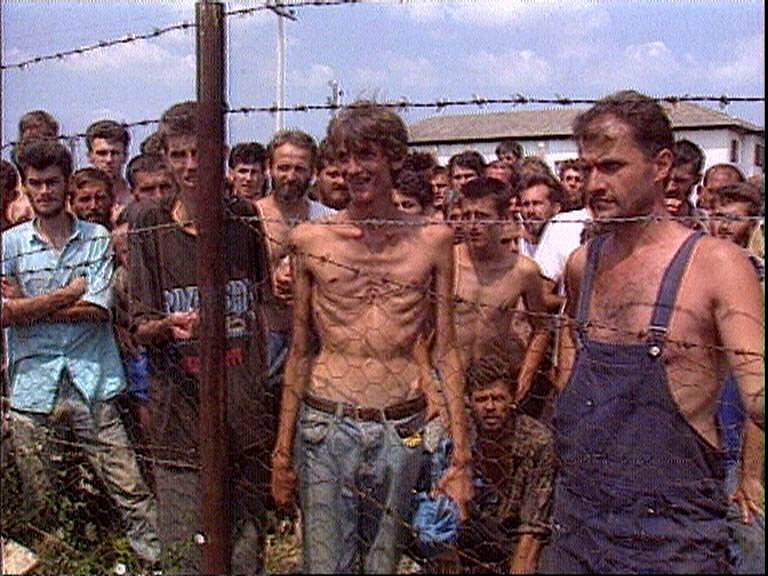
Among the many images of atrocity that emerged from the Bosnian War, the picture of Fikret Alic and others imprisoned at the Trnopolje camp in the Prijedor region stands out. Taken from a 1992 British television report that detailed the role of camps such as Omarska and Trnopolje in the ethnic cleansing strategy of the Bosnian Serb authorities, the image of Alic became the focal point of a controversy about how the Bosnian camps were represented, and the political impact and purpose of those representations. Resulting in a legal clash between Independent Television News (ITN) and Living Marxism (LM) magazine, this controversy is the subject of a two-part article, the full text of which can be seen here.
In Atrocity, Memory, Photography — part 1, the allegations concerning the filming of the Trnopolje inmates are considered in detail. In Atrocity, Memory, Photography — part 2 the argument moves beyond the specifics of the case and the camp to an exploration of the historical, political and visual context in which those specificities are located. This involves understanding the significance of the camps in terms of the Bosnian War and the history of the concentration camps, as well as discussing the issue of photography and the Holocaust to question how particular atrocities are represented. The articles conclude with the issue of intellectual responsibility and the politics of critique in cases such as these.
This is a theme taken up by David Walls’ important article on Project Censored’s claims about these images, which can be read here. Walls’ article drew responses from some of the revisionists we criticise, and he has posted this debate on his site.
The 1992 ITN news reports that are discussed in my articles can be seen on the Atrocity and Memory — Video page on this site. The images from the articles can be seen in the gallery below. These come mostly from the ITN news reports, but the work of other photographers — such as Ron Haviv — shows similar pictures from Trnopolje.
For updates on what happened to Fikret Alic, see the 4 August 2002 and 27 July 2008 articles in The Observer for details.
In November 2009 the issues surrounding the 1992 ITN news reports was replayed following a lecture tour to Ireland by Noam Chomsky. This underlined the way revisionists seeking to belittle the meaning of the Bosnian War continue to recycle untrue claims about the imagery from Trnopolje. I wrote three posts on this new phase in the controversy (here, here and here), the second of which includes my revealing correspondence with Chomsky. While I have focused on the reiteration of false claims about the ITN vs. LM case, Oliver Kamm has provided a fullsome critique of other moments of denial, especially with regard to Srebrenica, and has kindly linked to these pages for information on Trnopolje.
This page has some sub pages.
12 Responses to “Atrocity and Memory”
Goran M April 29th, 2009 at 6:28 pm #
Mister Campbell, why did the English judge say the picture of Fikret Alic was misrepresented? He claimed this before he ruled that LM was liable of slander for claiming that ITN doctored the photo intentionally.
David Campbell April 30th, 2009 at 8:08 am #
Goran M: The libel trial against Living Marxism for running the erroneous Thomas Deichmann story on Trnopolje was a jury trial. This means all determinations of fact, and the final judgment, was reached by the unanimous decision of twelve citizens, after they had heard all the arguments and seen all the evidence, including all the video. As such, the judge in the case, Mr Justice Morland, did not make any final rulings about who was right or wrong.
Despite this, many people who want to continue to discredit the story of Fikret Alic and revise our understanding of Trnopolje call attention to an opinion the judge expressed about the fencing in the camp. Most people wanting to make this case have relied on a BBC news story about the libel trial that contained a paraphrase of the judge’s opinion — but this BBC story was subsequently found to be misleading and unfair by the Broadcasting Standards Commission.
My articles above put everything in context and provide the detailed evidence. If you read part 1, pp. 20-21, you will see the judge’s comments quoted and discussed, and in part 1, p. 7, you will see the details of the inaccurate BBC story. The judge did not say the picture was a misrepresentation, though he did question parts of ITN’s account about the condition and location of the fences at Trnopolje. In the end, this was a minor and contested point that did not have any impact on the jury’s deliberation and unanimous decision. It certainly cannot be used to call the veracity of the Alic image and the full ITN report on Trnopolje into question. A full reading of my two articles demonstrates why that is a secure conclusion.
Henrik Ræder Clausen, Dansk Folkeparti og The Yugoslavia Death Camp Hoax « Bohemian Rhapsody July 26th, 2009 at 5:56 pm #
[...] Mener Henrik Ræder Clausen at TV-stationen ITN begik nogen form for uhæderlighed i forbindelse med deres famøse reportage fra Omarska og Trnopolje? (I parentes bemærket; den sidste der mente det endte med at tabe en injurie-sag). [...]
David Campbell October 27th, 2009 at 9:34 am #
The trial of Radovan Karadzic began in the Hague yesterday, and Fikret Alic was among the camp survivors quoted in news coverage — see http://www.guardian.co.uk/world/2009/oct/26/radovan-karadzic-war-trial
For a series of articles on the trial and its related issues go to http://www.guardian.co.uk/world/radovankaradzic
Karadzic, photography and revisionism | David Campbell -- Photography, Multimedia, Politics November 9th, 2009 at 8:42 pm #
[...] I have detailed extensively in my investigation “Atrocity, Memory, Photography,” a network of individuals originally associated with the RCP used the fundamentally flawed [...]
Chomsky’s Bosnian shame | David Campbell -- Photography, Multimedia, Politics November 16th, 2009 at 6:02 pm #
[...] the Prijedor region camps. So, having written the most detailed study available on this issue – Atrocity, Memory, Photography, a two-part academic article – last week I decided to write to Professor Chomsky and ask if he had, or was willing to read, my [...]
Open Letter to Amnesty International Regarding Chomsky’s Invitation to Speak, By Ed Vulliamy « Samaha November 24th, 2009 at 9:39 pm #
[...] is further commentary about the issue at David Campbell’s site that you can find here and [...]
The fundamentalist defence of Chomsky on Bosnia | David Campbell -- Photography, Multimedia, Politics November 27th, 2009 at 6:33 pm #
[...] because they simply recycle the discredited Thomas Deichmann and Philip Knightly allegations. My original 2002 investigation picked those apart, so trying to debate the likes of Herman and Petersen is largely pointless because of the way they [...]
Mr. D'Adamo February 20th, 2010 at 4:16 am #
Mr. Campbell, there is no denying that atrocities were committed by the Serbs however the atrocities committed by the Muslims were just as and if not greater. The targeting of the innocent based on there christian beliefs fueled there savagery. The Muslims whom we have seen based on post 911 and throughout history dictates that they are unwilling to allow the freedom of religion. It is either there way or no other. In viewing some horrific photo’s there’s was the use of sole sectarian use of wholesale terror based on christian beliefs. The UN, and others view only the Serbs as being worthy of war crimes. It is my belief that the Muslims are just as guilty if not more and are undeserving of any further legitimized treatment. Tell me Mr. Campbell what is the true intent of the Mujaheddin, who called upon Jihad and the christian who must be destroyed.
David Campbell February 21st, 2010 at 3:27 pm #
Mr D’Adamo – your comment is full of the very bigotry you supposedly object to. I find it objectionable on many counts, but have posted it as a reminder to myself and others about the toxic views people like yourself hold. Your prejudice is unsupported by any evidence and unrelated to the specific concern of my research in “Atrocity and Memory.” Casting the issue as one of ‘Christian’ vs ‘Muslim’ is to betray a considerable ignorance about the identities at stake in the Bosnian War, as is the suggestion that all participants were equally culpable.
A Critical Chomsky Reader « Untitled May 30th, 2010 at 9:23 am #
[...] David Campbell’s e-mail exchange with Chomsky, which links to Campbell’s detailed study of the concentration camps in Bosnia, “Atrocity, Memory, [...]
Owen June 3rd, 2010 at 9:53 am #
David, Roger Lippman has referred to “Atrocity, Memory, Photography” in “A Critical Chomsky Reader” (link in previous post). Although I didn’t refer specifically to it in my own contribution, in which I describe the outcome of my investigation of the LM claims, I want to express my appreciation to you for it once again. The two moments when all the individual pieces of information I had found confirming my doubts came together were when I read your essay and when I attended a talk by Kemal. Your rigorous, intelligent analysis and the transparent truth of Kemal’s testimony to his personal experience left no room for any lingering doubt about which side of the debate was informed by intellectual and personal honesty.
Have you seen the interview Fikret Alic gave to the Bosnian television programme 60 Minuta? It’s at YouTube – http://www.youtube.com/watch?v=W2sO-XcI9FQ (English subtitles)