Atrocity and Memory
Atrocity, memory, photography: imaging the concentration camps of Bosnia – the case of ITN versus Living Marxism
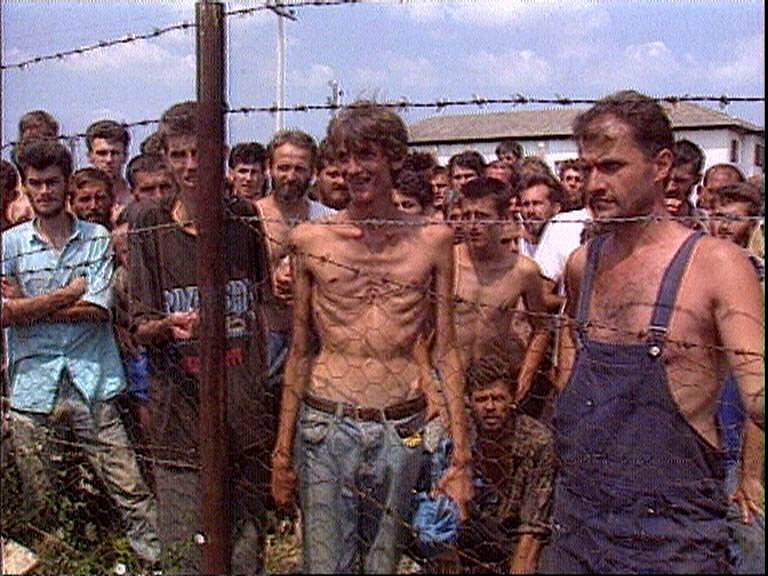
Among the many images of atrocity that emerged from the Bosnian War, the picture of Fikret Alic and others imprisoned at the Trnopolje camp in the Prijedor region stands out. Taken from a 1992 British television report that detailed the role of camps such as Omarska and Trnopolje in the ethnic cleansing strategy of the Bosnian Serb authorities, the image of Alic became the focal point of a controversy about how the Bosnian camps were represented, and the political impact and purpose of those representations. Resulting in a legal clash between Independent Television News (ITN) and Living Marxism (LM) magazine, this controversy is the subject of a two-part article, the full text of which can be seen here.
In Atrocity, Memory, Photography — part 1, the allegations concerning the filming of the Trnopolje inmates are considered in detail. In Atrocity, Memory, Photography — part 2 the argument moves beyond the specifics of the case and the camp to an exploration of the historical, political and visual context in which those specificities are located. This involves understanding the significance of the camps in terms of the Bosnian War and the history of the concentration camps, as well as discussing the issue of photography and the Holocaust to question how particular atrocities are represented. The articles conclude with the issue of intellectual responsibility and the politics of critique in cases such as these.
This is a theme taken up by David Walls’ important article on Project Censored’s claims about these images, which can be read here. Walls’ article drew responses from some of the revisionists we criticise, and he has posted this debate on his site.
The 1992 ITN news reports that are discussed in my articles can be seen on the Atrocity and Memory — Video page on this site. The images from the articles can be seen in the gallery below. These come mostly from the ITN news reports, but the work of other photographers — such as Ron Haviv — shows similar pictures from Trnopolje.
For updates on what happened to Fikret Alic, see the 4 August 2002 and 27 July 2008 articles in The Observer for details.
For subsequent updates, see the comments below after the gallery.
This page has some sub pages.
3 Responses to “Atrocity and Memory”
David Campbell April 22nd, 2009 at 7:23 pm #
Seventeen years after the event, notwithstanding all the evidence in the articles and images above, there are those who still make unsupportable claims about the 1992 picture of Fikret Alica at Trnopolje.
On 6 April 2009, Edward Herman, sometime co-author with Noam Chomsky, wrote an article on the alleged demonization of the Serbs (see http://www.fpif.org/fpiftxt/5973) in which he stated:
“An important part of the fix was dishonest demonization, as with the famous August 1992 picture of Fikret Alic, an emaciated prisoner behind barbed wire in a Serb ‘concentration camp.’ But the UK journalists had pushed forward a man who was sick and quite unrepresentative: the barbed wire was around the journalists, not the camp, and it was a transit camp, not a concentration camp.”
Herman’s claims about the nature of the camp, who was detained there, and the journalists conduct, are totally without foundation. (His other points are dealt with in a response by John Feffer – see http://www.fpif.org/fpiftxt/5972).
Why does Herman feel able to constantly repeat claims that are countered by the evidence and demonstrably untrue?
Goran M April 29th, 2009 at 6:28 pm #
Mister Campbell, why did the English judge say the picture of Fikret Alic was misrepresented? He claimed this before he ruled that LM was liable of slander for claiming that ITN doctored the photo intentionally.
David Campbell April 30th, 2009 at 8:08 am #
Goran M: The libel trial against Living Marxism for running the erroneous Thomas Deichmann story on Trnopolje was a jury trial. This means all determinations of fact, and the final judgment, was reached by the unanimous decision of twelve citizens, after they had heard all the arguments and seen all the evidence, including all the video. As such, the judge in the case, Mr Justice Morland, did not make any final rulings about who was right or wrong.
Despite this, many people who want to continue to discredit the story of Fikret Alic and revise our understanding of Trnopolje call attention to an opinion the judge expressed about the fencing in the camp. Most people wanting to make this case have relied on a BBC news story about the libel trial that contained a paraphrase of the judge’s opinion — but this BBC story was subsequently found to be misleading and unfair by the Broadcasting Standards Commission.
My articles above put everything in context and provide the detailed evidence. If you read part 1, pp. 20-21, you will see the judge’s comments quoted and discussed, and in part 1, p. 7, you will see the details of the inaccurate BBC story. The judge did not say the picture was a misrepresentation, though he did question parts of ITN’s account about the condition and location of the fences at Trnopolje. In the end, this was a minor and contested point that did not have any impact on the jury’s deliberation and unanimous decision. It certainly cannot be used to call the veracity of the Alic image and the full ITN report on Trnopolje into question. A full reading of my two articles demonstrates why that is a secure conclusion.